



Philosophical Messages in Kertha Gosa Paintings Klungkung Bali
12 February 2026Kertha Gosa in Klungkung has been known as a heritage of the royal period. Until now, it has remained well-maintained. The building features a classic atmosphere. There are a number of stories contained in the paintings mounted on the ceiling. What are they? The name of Kertha Gosa has been very famous not only in Balinese society, but also overseas. The historical heritage located in the south of Puputan Klungkung Monument becomes one of the tourist destinations in Klungkung, east Bali.
When coming in, the classic atmosphere can be felt intensely. The Kertha Gosa building in the northeast corner still shows its taksu or divine vibration. Its foundation is made from hard sandstone. The poles of the building with a palm fiber roof covered with carvings give the impression of the past time. The gold leaf color of some paintings has looked to fade, but it still looks beautiful. They are no less beautiful when compared to the carvings of today.
In the center of the building, there are carved tables and chairs. According to the story, during the kingdom era, it is believed to be the venue for discussion on everything related to the security situation, prosperity, and justice of the kingdom region in Bali. Besides, this pavilion served as a venue for meetings for the subordinate kings throughout Bali, held every full moon of the fourth month in the Balinese calendar (October). Here, the royal officials provided direction and decisions based on considerations of the circumstances and needs.
When observed further, the ceiling of this building is adorned with paintings. They have very distinctive colors. Additionally, they look natural with a touch of color in the rocks. Aside from offering very classic nuance, it contains meaningful philosophy. All of them are displayed in plots. Its beauty and uniqueness can draw the attention of many visiting tourists. They are quite curious about the meaning contained therein.
The paintings have existed since the beginning of the building. One by one, it is explained based on the existing references. At the bottom plot, the story tells about Tantri Kandaka, the 1001-night stories, whose essence is about all the deceit in society. The second and third plots carry about the Atma Presangsa, depicting the suffering of the souls in Hell found by Bima Sena (the second son of the Pandavas in the Mahabharata Epic) on his way to find out the souls of his father and mother.
The fourth plot is about the eagle seeking amrita (holy water of life), taken from Adi Parwa, a story that illustrates how difficult it is to earn a living in the world. Meanwhile, the fifth plot tells about palelindon (forecast and meaning of earthquakes). The sixth and seventh plots tell about Bima Sena when meeting with divine and celestial deities and fighting to save the souls of his father and mother.
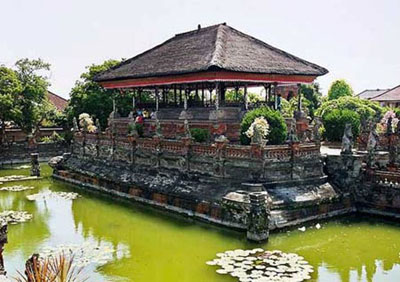
Meanwhile, the eighth plot tells about the heaven of the souls and the ninth plot about the God who serves as the keeper of the balance of the four points of the compass of the world. These paintings become one of the tourist attractions. Right in the middle of this building area is the Taman Gili. The local community is more familiar with the name of Balai Kambang (literally means "the floating pavilion"), surrounded by a fish pond with water lilies. To get there, visitors should take some steps that also show the old impression. This building has many poles. The carving is similar to the ones in the Kertha Gosa. This also draws the attention of visitors as intrigued by the story of the paintings on the ceiling.
Near the brick-using foundation building, there is a small note explaining the meaning of the paintings. The first plot below tells the story about the destiny of a person predetermined by the day of birth. The second plot depicts the story of Pan Berayut, a fairy tale about a couple having 18 children. As for the third to sixth plot tells about the story of Sutasoma, the work of the renowned poet, Mpu Tantular during the reign of King Hayam Wuruk in Majapahit in 1365.